
The Housing Ombudsman ruled against St Albans council in 33 of 40 findings in 2025/26 and ordered £9,345 in compensation. Repairs drew the most complaints.
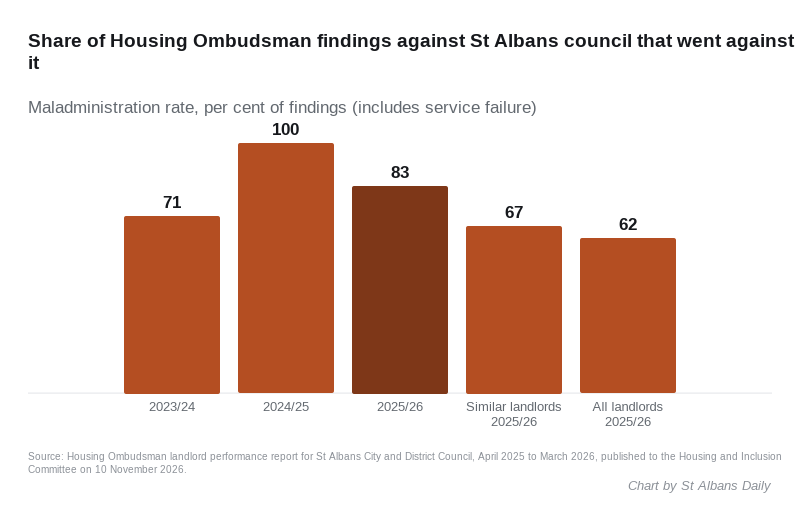
The Housing Ombudsman found against St Albans City and District Council in 33 of 40 findings about its council homes in 2025/26. That is a maladministration rate of 83%, against 62% for all social landlords in England. The ombudsman ordered the council to pay £9,345 in compensation to tenants, three times the year before.
The figures are in the ombudsman’s annual landlord performance report for the council, which owns 5,851 homes. It was on the agenda of the council’s Housing and Inclusion Committee on 10 November, with a covering report on what is being done about it.
The report covers cases the ombudsman decided between April 2025 and March 2026. Most of the complaints behind them are older. The council says some go back to January 2023.
The figures
The ombudsman can only look at a complaint once a tenant has been through the council’s own complaints process. In 2025/26 it decided 15 cases, up from six the year before. They produced 44 findings:
| Finding | Number |
|---|---|
| Maladministration | 24 |
| Service failure | 9 |
| Reasonable redress | 1 |
| No maladministration | 6 |
| Outside its remit | 4 |
Service failure counts towards the maladministration rate. There were no findings of severe maladministration.
The rate has come down from 100% in 2024/25, when all 11 findings went against the council. It was 71% in 2023/24. But it is still above the 67% the ombudsman gives for landlords of a similar size and type.
The other measure the ombudsman uses is findings against a landlord for every 1,000 homes it owns. St Albans recorded 5.6. The median for similar landlords is 1.0.
What the complaints were about
Repairs made up the biggest group. The council’s report breaks the in-remit findings down by area:
- Repairs: 16 of 18 went against the council (89%, against 72% nationally)
- Managing relations with tenants: 9 of 11 (82%, against 57% nationally)
- Antisocial behaviour: all 4 (100%, against 66% nationally)
- Planned works: 2 of 3
- Moving, buying or selling a home: 2 of 2
The most common single issues were complaint handling (11 findings), other repairs (7) and condensation, damp and mould (5).
The ombudsman made 67 orders, up from 20. They included 30 for compensation, 14 for an apology and eight to carry out repairs. Repairs cases accounted for £5,110 of the £9,345.
What the council says
The council’s report calls the year a “mixed picture”. It says the rise in cases reflects older complaints reaching a conclusion, and a national rise in complaints to the ombudsman. It also says it complied with all 67 orders on time.
It says the results show “evidence of progress, but not yet of satisfactory performance”. It accepts that its rate per 1,000 homes is “outside the expected range”.
The improvements it lists include:
- complaint audits twice a year, reported to the committee
- weekly meetings to track complaint responses and follow-up work
- two new posts to monitor complaints, and an extra post in the corporate complaints team
- a review of the root cause of every ombudsman decision, from this quarter
It says its own audit scores for the quality of complaint replies rose from 12.67 out of 25 in September 2025 to 19.6 in September 2026.
What it means for you
- If you are a council tenant with a problem, report it to the council first. The ombudsman will only investigate after you have been through the council’s complaints process.
- If you are unhappy with the council’s final answer, you can take the complaint to the Housing Ombudsman. It is free.
- If you have damp or mould, report it in writing and keep a record. It was one of the most common issues the ombudsman upheld against the council.
Have your say