
The £100 Household Energy Payment goes to council tax bands A to D from January 2027. In St Albans that is 31,240 homes, 49%, the lowest share in Hertfordshire.
The government’s one-off £100 Household Energy Payment will go to homes in council tax bands A to D. In the St Albans district that covers 31,240 homes, 49% of the total. No other council area in Hertfordshire has a smaller share of its homes in those bands.
Payments are expected to start in January 2027.
Overview
- How much: £100, paid once, for this financial year
- Who gets it: households in council tax bands A to D, where the home is their sole or main residence
- When: councils are expected to start paying from January 2027
- How: through the council tax system, run by St Albans City and District Council as the billing authority
- Homes in bands A to D in the district: 31,240 of 63,740 (49%)
- Homes in bands E to H: 32,500, which are outside the main scheme
- Help for others: a £100 million discretionary fund for councils to share out, including to some homes above band D
What the government has said
The Ministry of Housing, Communities and Local Government set out the scheme in a letter to councils dated 28 October 2026, the day of the Budget. It says the payment is aimed at homes occupied as a sole or main residence. It expects the payment to reach more than 20 million households in England this winter.
The letter also announces a £100 million discretionary fund. Councils can use it for “households most acutely impacted by rising energy bills, some of which are in council tax bands above A to D”.
Detailed guidance on who qualifies, how the money is paid and how the discretionary fund works has not been published yet. The letter says it will follow “shortly”.
What St Albans council has said
The district council’s own budget report for its Strategy and Resources Committee on 19 November confirms it will run the scheme locally. The report says payments to households in bands A to D “will not commence before January 2027”. It adds that the discretionary hardship scheme is expected to start later than that.
The government has not yet told the council how much it will get for the scheme. The council had not published its own arrangements on its news page by 15 November.
Why St Albans is different
The Valuation Office Agency counts every home on the council tax list. Its latest figures, as at 8 September 2026, show how few St Albans homes sit in the lower bands:
| Band | Homes in St Albans district |
|---|---|
| A | 890 |
| B | 3,220 |
| C | 10,590 |
| D | 16,540 |
| E to H | 32,500 |
| All homes | 63,740 |
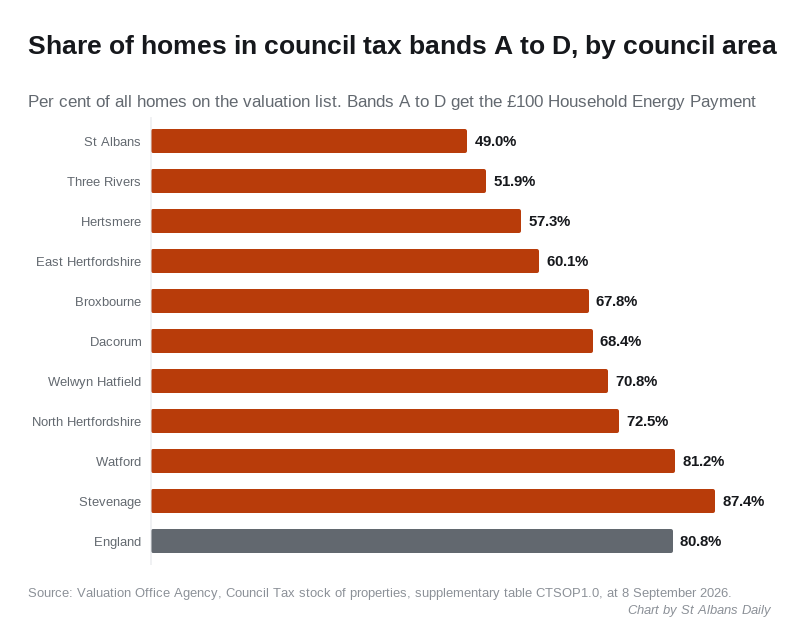
That puts 49.0% of the district’s homes in bands A to D. Across England the figure is 80.8%, and across Hertfordshire it is 65.9%. In Stevenage it is 87.4%, and in Watford 81.2%.
St Albans has the lowest share of the ten Hertfordshire districts. It is also among the ten lowest of all council areas in England, alongside places such as Elmbridge, Mole Valley and Richmond upon Thames.
These counts include empty homes and second homes, which are not a sole or main residence. So the number of St Albans households that actually receive the £100 will be lower than 31,240.
Council tax bands in England still rest on what a home would have sold for on 1 April 1991. Under the Local Government Finance Act 1992, band D covers values above £68,000 and up to £88,000. Anything above that is band E or higher.
What it means for you
- Check your band. You can look up any address on the government’s council tax band checker. Your annual bill also shows it.
- Bands A to D: if the home is your main residence, the government expects you to get the £100 through the council tax system from January. The exact method has not been announced, so there is nothing to apply for yet.
- Bands E to H: you are outside the main scheme. The discretionary fund can help some households above band D, but the rules for it have not been published.
- For what each band pays here this year, see the St Albans council tax bands for 2026/27.
We will update this story when the government publishes its guidance and the council sets out how it will pay.
Have your say