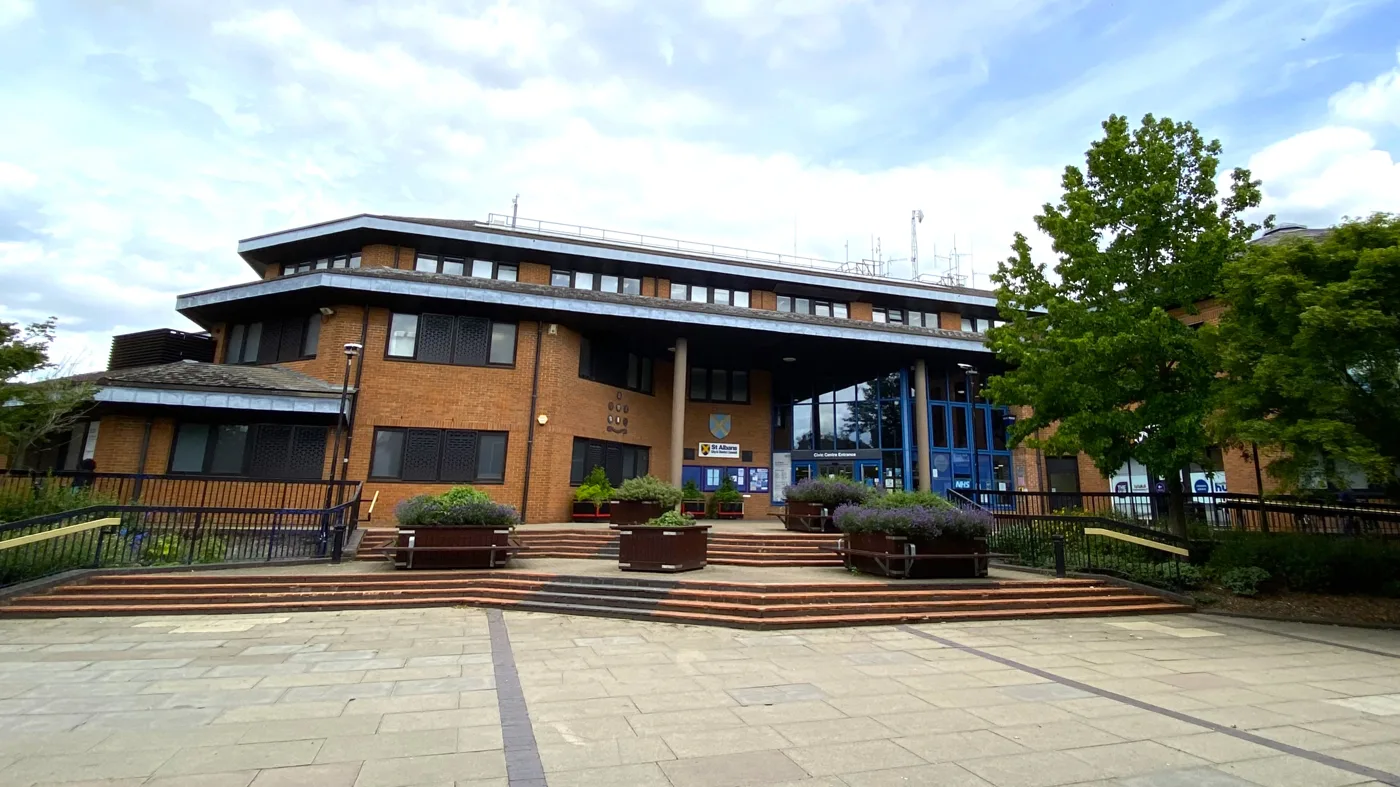

From Saturday, officers alone decide extensions and schemes under 10 homes in St Albans district. Councillors can no longer call them in to committee.
From Saturday 31 October, St Albans councillors can no longer call in a planning application to be decided at a committee meeting. Home extensions and schemes of fewer than ten homes will be decided by planning officers, with no route to committee at all.
The change comes from national rules that apply to every planning authority in England. St Albans City and District Council announced what it means locally on Thursday.
What changes on Saturday
The rules are the Town and Country Planning (Discharge of Local Planning Authority Functions) (England) Regulations 2026, made under the Planning and Infrastructure Act 2025. The government’s statutory guidance says they come into force on 31 October 2026. They sort applications into two lists.
Schedule 1: officers must decide. These include:
- householder applications, such as extensions, loft conversions and garden rooms
- minor commercial development
- minor residential development: one to nine homes on a site smaller than half a hectare
- discharging planning conditions and prior approvals for permitted development
- certificates of lawfulness
- reserved matters on outline permissions below 500 homes
Schedule 2: officers decide unless two people agree otherwise. These include larger housing and commercial schemes, listed building consent, advertisement consent and works to protected trees.
A Schedule 2 application can only go to committee if it passes at least one of two tests. It must raise an economic, social or environmental issue “of significance to the local area”, or a significant planning matter under the local plan.
Two people decide whether it passes: the council’s nominated planning officer and a nominated councillor, normally the committee chair. If they disagree, officers decide the application. The guidance says committee referral should happen “only exceptionally”.
Two habits of local councils end altogether. The guidance says ward councillors can no longer require a case to be called in. Rules that send an application to committee once it draws a certain number of objections go too.
Planning committees are also capped at 13 councillors. The council says that is already the size of its Development Management Committee.
What the council says
Councillor Paul de Kort, the council’s leader and chair of its Planning Policy and Climate Committee, called the changes “a fundamental shift in how planning applications in our District will be decided”.
“We have an excellent team of highly professional planning officers who will be able to rise to the challenge, but this will inevitability result in less democratic oversight overall,” he said.
“Residents should be aware that their elected representatives will be deciding significantly fewer planning applications and, not necessarily, the most contentious in their neighbourhood.”
How much the committee decided this year
St Albans already sent few applications to committee. We went through the Development Management Committee’s 2026 meetings on the council’s committee website.
- Seven meetings went ahead, on 20 January, 2 and 23 February, 8 June, 6 July, 3 August and 30 September
- Six were cancelled, on 12 January, 18 March, 29 April, 11 May, 7 September and 12 October
- Thirteen different applications appeared on the agendas of the meetings that went ahead
Some of those could not reach committee under the new rules. On 8 June the committee considered a rear garden room with an air-conditioning unit at 94a Clarence Road. That is a householder application, which officers must now decide.
Three other agenda items this year were applications for a single new house:
- a new plot beside an existing house (5/2025/1462)
- land behind 50 Woodstock Road North, reached from Gleave Close (5/2025/1680)
- a replacement house at 4 The Mall, Park Street, about two miles south of the city (5/2026/0244)
A single house falls in Schedule 1 when the site is under half a hectare.
So did one of the year’s biggest items. On 23 February the committee considered the reserved matters, the detailed design, for 150 homes on land behind Forge End in Chiswell Green, about two miles south west of the city. Its outline permission was granted at appeal. Reserved matters on any outline permission below 500 homes are now in Schedule 1, so officers must decide them.
New full or outline applications for larger schemes fall in Schedule 2. On 20 January the committee considered an outline plan for up to 300 homes between Flamsteadbury Lane and Gaddesden Lane in Redbourn, about four miles north west of St Albans. A scheme like that could still reach committee, but only through the two-person test.
The committee’s next meetings are on 30 November and 15 December.
What it means for you
- If you object to a neighbour’s extension, your objection still counts. Officers must weigh it. But your councillor can no longer ask for the decision to be taken in public at committee.
- If you are applying for an extension or a small scheme, the decision will come from an officer. A refusal goes to appeal, as before.
- If a big scheme matters to you, ask your ward councillor to press the nominated councillor and officer to refer it. They must agree it passes one of the two tests.
- Comment on applications through the council’s planning register, and follow the district’s bigger applications on our planning news page.
Sources
- Major changes announced on how planning applications are decided, St Albans City and District Council, 29 October 2026, for the local effect, the committee size and the leader’s comments.
- Planning Committees and the National Scheme of Delegation of Planning Functions: Guidance for local planning authorities in England, Ministry of Housing, Communities and Local Government, 1 June 2026, for the two schedules, the tests, the end of call-in and objection triggers, and the 13-member cap.
- Development Management Committee meetings, St Albans City and District Council, read on 30 October 2026, for the meetings held and cancelled in 2026 and the applications on each agenda.
Have your say