
Full Council approved a new parish council for central St Albans on 15 July: 25 councillors across nine wards, elected 6 May 2027. Harpenden Rural is abolished.
The centre of St Albans is getting a parish council for the first time. On 15 July 2026 Full Council approved the final recommendations of its Community Governance Review, creating St Albans City Centre Parish, covering the part of the city that has never been parished. It will have 25 parish councillors and its first elections will be held on 6 May 2027. The decisions are published on the council’s Community Governance Review: Final recommendations page.
Two other places change at the same time. Harpenden Rural Parish Council will be abolished and its area absorbed into Harpenden Town Council, and London Colney’s parish council grows from nine councillors to fifteen. Six parishes are left alone entirely.
What the new city centre parish looks like
The new parish is divided into nine parish wards, drawn on the existing district ward boundaries. Eight of the nine return three councillors each; Marshalswick West returns one, because only part of that district ward falls inside the parish.
| Parish ward | Parish councillors |
|---|---|
| Batchwood | 3 |
| Bernards Heath | 3 |
| Clarence | 3 |
| Cunningham | 3 |
| Hill End | 3 |
| Marshalswick West | 1 |
| Sopwell | 3 |
| St Peters | 3 |
| Verulam | 3 |
| Total | 25 |
The council has published a map of the new parish ward boundaries (PDF).
When the recommendation was made in June, the council said the unparished area covers more than 28,000 households, and that parish councils “can be responsible for delivering grassroots services like allotments, green spaces and public toilets”. It also made clear that it will be for the new parish council, once established, to decide what assets and services it wants to take on, “negotiating any transfer with those councils that currently run the services or look after the assets”.
It can charge you a precept
This is the part that will reach your bill. The council’s June statement says that once established, the new parish council “would be able to charge householders a precept on their Council Tax to help pay for its operations”. No figure has been set, and it will not be set until the new council exists.
The set-up costs are to be met by the district council and “re-claimed once the Parish Council is established”.
Harpenden Rural disappears into Harpenden Town
Harpenden Rural Parish Council is abolished. Its area joins Harpenden Town Council, and the Harpenden North town ward is extended to take it in and renamed Harpenden North & Rural. Everything else about Harpenden Town Council, including its councillor numbers, stays as it is.
London Colney gets six more councillors
London Colney Parish Council goes from nine councillors to fifteen. Its outer boundary is unchanged, but it is divided into seven parish wards:
| Parish ward | Parish councillors |
|---|---|
| Alexander | 2 |
| Caledon | 2 |
| Kings | 3 |
| London Colney South | 2 |
| Napsbury Park | 3 |
| St. Annes | 2 |
| White Horse | 1 |
| Total | 15 |
There is a ward boundary map (PDF) for this one too.
Nothing changes for Colney Heath, Redbourn, Sandridge, St Michael, St Stephen and Wheathampstead. Their outer boundaries, warding and electoral arrangements all stay as they are.
What residents actually said
The review ran over two rounds of consultation. The first, from 4 August to 6 October 2025, drew 1,957 submissions from residents, parish and town councils, residents’ associations and community groups, according to the council’s Community Governance Review page. The second ran for 11 weeks from 8 December 2025 to 23 February 2026 and drew close to 6,000 responses: 686 people used the online questionnaire, email or post, and 5,169 households took part in local polls held in Harpenden Rural Parish, Highfield and the unparished area of St Albans, as the council reported in February.
In the unparished area, ballot papers went to 27,608 households asking whether a new parish council should be set up. 78% (3,857) voted yes and 22% (1,088) voted no, on a turnout of 18.1%.
One proposal was dropped. A separate parish council had been floated for Highfield, but with “barely 1,000 households” the council judged it was not viable. Highfield instead sits inside the new city centre parish.
Why now
The trigger is the abolition of the district council itself. The council’s own review page says that under government plans, St Albans City and District Council and every other Hertfordshire district, along with the county council, “will be abolished in 2028 and replaced by unitary local government structures”, and that the review was launched before that happens.
Cllr Paul de Kort, the council leader, put it directly in June: other communities in the district “including Harpenden, Redbourn, London Colney and Wheathampstead have parish councils in place, and with Local Government Reorganisation looming for the District Council, which will be abolished and replaced with a larger Unitary Council in 2028, it has been deemed the right time for the residents of central St Albans to have one too.”
We have written separately about that reorganisation: the July plan to merge St Albans with Dacorum into a new West Hertfordshire Council.
Update, 11 September 2026: on 7 September the government put that plan under review and told councils to stop work on it. The parish decision is the council’s own and is separate. When we checked on 11 September, the council’s final recommendations page still gave 6 May 2027 for the new parish’s first elections.
The dates to know
The council has published the full timetable:
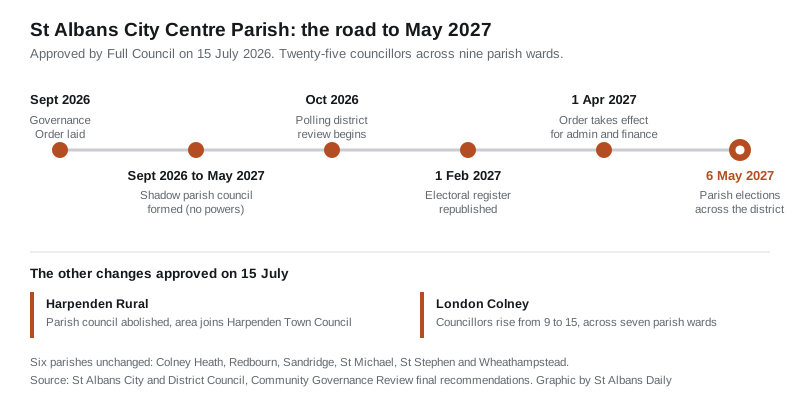
- September 2026: a Reorganisation of Community Governance Order is laid. This is the legal document that puts the changes into effect.
- September 2026 to May 2027: a Shadow Parish Council is set up for St Albans City Centre Parish. The council says more information will be published once available.
- October 2026 to February 2027: a review of polling districts and polling places, to see what needs to change as a result.
- 1 February 2027: the electoral register is republished on the new parish boundaries and arrangements.
- 1 April 2027: the Order takes effect for administrative and financial purposes.
- 6 May 2027: parish and town council elections across the district.
What it means for you
If you live in central St Albans, you get a new tier of local government and a new line on your council tax. The parish council will be able to set a precept. How much is not yet decided and cannot be until the council exists.
If you want to stand, the election is on 6 May 2027 and there are 25 seats across nine wards. The shadow parish council being formed from September 2026 is a preparatory body without decision-making powers, so the first elected councillors will be the ones who decide what the parish actually does.
If you live in Harpenden Rural, your parish council is going. You will be represented by Harpenden Town Council instead, in a ward renamed Harpenden North & Rural.
Check your polling station before you vote in 2027. The polling district review runs from October 2026 to February 2027 specifically because these boundary changes may move some polling places, and the register is republished on 1 February 2027.
For the rest of what the council is deciding locally, see our St Albans planning news and roadworks and travel pages.
Have your say