
The July plan to abolish St Albans council in 2028 and merge it with Dacorum is paused under a government review. What the decision said, and what still stands.
Update, 11 September 2026: on 7 September the government put this decision under review and told councils to stop work on implementing it. Elections in May 2027 now go ahead to the existing councils, not to West Hertfordshire Council, and the 1 April 2028 date depends on the review. The article below reports the July decision as it was made. Read what has changed.
Under the July decision, St Albans City and District Council was to be abolished on 1 April 2028 and its area merged with Dacorum into a single new authority whose legal name is West Hertfordshire Council, with 84 councillors. That is the decision the Secretary of State for Housing, Communities and Local Government, Steve Reed, set out in a letter to Hertfordshire’s council leaders dated 16 July 2026, and the names and councillor numbers were fixed a few days later in a letter to the county’s chief executives dated 21 July.
Both letters are public, and they contain a good deal that the press releases did not. Two things in them matter most locally. The first is that the government’s own consultation found more support for the rival plan that St Albans council itself helped write, and it was not the plan chosen. The second is that the word “City” cannot appear in the new council’s legal name.
The plan St Albans backed was the one residents rated highest, and it lost
Three competing proposals went to the government in November 2025. St Albans City and District Council co-authored one of them with Hertfordshire County Council: a two-unitary split of the county, with St Albans in a West Hertfordshire council alongside Dacorum, Hertsmere, Three Rivers and Watford. A three-unitary plan came from East Herts, Three Rivers and Watford. The four-unitary plan that won came from Broxbourne, Dacorum, Hertsmere, North Hertfordshire, Stevenage and Welwyn Hatfield. All of this is set out in the government’s summary and analysis of consultation responses, published on 22 July.
The statutory consultation ran from 5 February to 26 March 2026 and drew 1,831 responses, of which 27 came from named consultees such as councils, health bodies and the police, and 1,804 from everyone else. Of those, 1,686 were individuals living in Hertfordshire.
Averaged across the multiple-choice questions, no proposal drew more agreement than disagreement from the public. But the two-unitary option was the least disliked, and the four-unitary option that the government picked was not:
| Proposal | Positive | Negative | Neither or don't know |
|---|---|---|---|
| 2 unitary | 39% | 49% | 12% |
| 3 unitary | 29% | 54% | 16% |
| 4 unitary (chosen) | 32% | 53% | 13% |
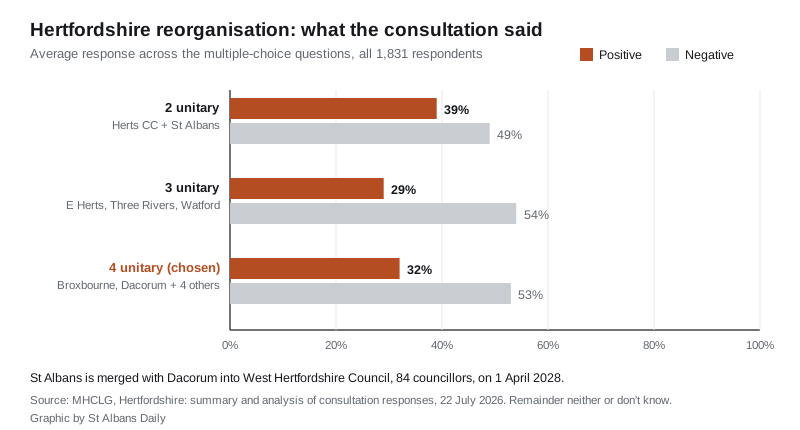
Among individuals living in Hertfordshire, the pattern is the same: 38% positive and 50% negative on the two-unitary plan, against 31% positive and 54% negative on the four-unitary plan. Among organisations, the gap is wider still, at 54% positive for two unitaries and 32% for four.
The one group that preferred the winning plan was the named consultees, the councils and public bodies formally asked for a view. They scored the four-unitary option 50% positive and 22% negative, against 47% and 30% for the two-unitary option. Among principal councils alone, on the question of whether each proposal was based on sensible geographies, all four councils answering on the four-unitary plan were positive, and all three answering on the two-unitary plan were negative.
Why the government chose it anyway
A consultation is not a vote, and the decision letter does not pretend otherwise. Steve Reed wrote that “although all the other proposals met the criteria for unitary local government”, he judged the four-unitary option best because it “better supports strong links to local communities”, allows “a more tailored approach to public service delivery”, and “better recognises Hertfordshire’s distinct economic areas”.
On the area St Albans is joining, described in the proposal as ‘North West’, the letter says it “has high-performing centres, history and culture, natural assets and the planned Hemel Garden Communities”.
The letter is candid about the trade-off. It accepts “the additional complexity of the required boundary change and disaggregation of services”, and that “the two unitary proposal had benefits in terms of delivering savings in the short term and a simpler disaggregation of services”. It also concedes that the chosen option “may take longer to payback the upfront costs of reorganisation”. On the fact that all four new councils fall below the 500,000-population figure the government had used as a yardstick, Reed wrote that the figure “has always been a guiding principle, not a fixed threshold”.
He made one change to the winning plan. Arbury ward in North Hertfordshire, population 2,880, goes into ‘Central’ rather than ‘Eastern’ because of “its links to Baldock and the A1 corridor”. Every other boundary change the proposing councils asked for was granted.
Cllr Paul de Kort, leader of St Albans City and District Council, said in the council’s own statement that the government had “chosen to ignore its own guidance surrounding population size and boundary consistency”, and that he was “particularly concerned about the ability of residents to continue to enjoy the high quality, discretionary provision, such as leisure and culture provision, CCTV protection and fly-tipping prevention, that this council currently offers”.
The four new councils
| New council | Replaces | Councillors |
|---|---|---|
| West Hertfordshire Council | Dacorum, St Albans | 84 |
| South West Hertfordshire Council | Hertsmere, Three Rivers, Watford | 79 |
| Central Hertfordshire Council | North Herts less five wards, Stevenage, Welwyn Hatfield less one ward | 89 |
| East Hertfordshire and Broxbourne Council | Broxbourne, East Herts, plus five North Herts wards and one Welwyn Hatfield ward | 75 |
Hertfordshire County Council is abolished along with the districts, so the new West Hertfordshire Council will run county services here too: social care, children’s services, schools, libraries and highways, alongside bins, planning, housing and council tax.
“City” cannot be in the name, so city status needs a separate fix
St Albans is a city. The new council covering it will not be able to say so in its legal name. The implementation letter is explicit that “‘City’ will not be included in the legal name for councils as conferral of city status is a matter of Royal prerogative”, and that it is “not possible to use the -ern suffix” or dashes either, which is why the area proposed as ‘North West’ is legally West Hertfordshire Council.
City status itself is not lost. It is “conferred by the Monarch and applies to a defined locality”, and the letter says arrangements “need to be put in place to ensure that this status is preserved”. Where the council structure no longer lines up with the area originally granted the status, “Charter Trustees are the usual legislative solution”, and they “may be established for unparished areas” to hold historic property such as charters and insignia.
That last phrase matters here, because central St Albans is about to stop being an unparished area. On 15 July the council approved a new St Albans City Centre Parish Council for exactly that area, with its first elections in May 2027. Nothing published so far says which route will carry the city status. The government’s letter says further legislation will cover “ceremonial matters that need specific provision, such as Lord Lieutenants or Charter Trustees”, and that it expects that supplementary order to come into force in time for 1 April 2028.
Separately, the letter notes that once established, any new council can change its name under section 74 of the Local Government Act 1972 with a two-thirds majority of members voting, and that councils “can use a name other than their legal name for branding and local identity purposes”.
The timetable, and a deadline that falls today
The implementation letter sets out what happens next, and one of its dates is today. The Ministry asked Hertfordshire’s chief executives for further information by 17 August on three things: which council’s head of paid service should be the returning officer for each new council, suggested interim warding arrangements for the new councils, and the current electoral cycles for parish councils. It also asked them to confirm by the same date which council should receive the transition grant.
Ministers said they would consider “any further unanimous representations” on matters such as names and councillor numbers if made by 17 August, though “the final decision on what to include in the legislation is ultimately for the Secretary of State”.
- September 2026: the government expects to share a draft Structural Changes Order with the councils.
- 2027: the Order is expected to be made and come into force, after scrutiny by the Joint Committee on Statutory Instruments and the Lords Secondary Legislation Scrutiny Committee, a debate in a committee of each House and approval motions in both.
- May 2027: elections to the four new councils. These replace any local elections otherwise scheduled for that month, and sitting councillors “will have their terms extended”.
- May 2027 to March 2028: the elected members run “shadow” councils, setting budgets and plans.
- 1 April 2028: the new councils take over and the existing ones are abolished.
Until then, the letter is clear that “your councils will remain responsible for services in your areas until they are abolished on 1 April 2028”. A joint committee will be set up for each new council, with half its members from the county council and half from the districts. For West Hertfordshire that is four county councillors and four from Dacorum and St Albans. A single implementation team covering all four areas will be led by Hertfordshire County Council’s head of paid service.
The government has also said it expects to issue a direction under section 24 of the Local Government and Public Involvement in Health Act once the Order is in force, requiring existing councils to get consent from the shadow councils before entering certain contracts or disposing of certain assets.
The money
The Secretary of State has agreed £900,000 per new unitary for transition costs, which for Hertfordshire is £3.6m in total, paid by section 31 grant during 2026/27. On top of that, each new unitary gets up to £150,000 for leadership capacity in children’s services, adult social care and public health, from a wider £10m pot inside the government’s £63m capacity fund. Reed’s letter says areas undergoing reorganisation “will receive more than £1 million per new unitary created”.
What it means for you
Nothing changes to your services or your bill yet. St Albans City and District Council still collects your bins, sets your council tax, and decides your planning applications until 31 March 2028. Hertfordshire County Council still runs schools, social care and roads until the same date.
Your next local election is the district council’s after all (updated 11 September 2026). Under the July decision, elections in May 2027 would have been to the new West Hertfordshire Council and would have replaced the district elections. Since the 7 September review, the government says elections scheduled for May 2027 go ahead to existing council boundaries, and the council’s elections page lists St Albans City and District Council elections on 6 May 2027.
You will be voting on two things in May 2027, not one. If you live in the central, currently unparished part of St Albans, the same period brings elections to the new St Albans City Centre Parish Council on 6 May 2027, which is a separate body from the unitary council and can charge its own precept on your council tax.
Nothing here is final until Parliament votes. Every part of the decision is expressly “subject to Parliamentary approval” of the Structural Changes Order, which is not expected to be made until 2027.
The council keeps its own summary on its Local Government Reorganisation page, and the government’s decision letters for all 14 areas are published on gov.uk.
We also track St Albans planning decisions, house prices across the district and roadworks and travel.
Have your say